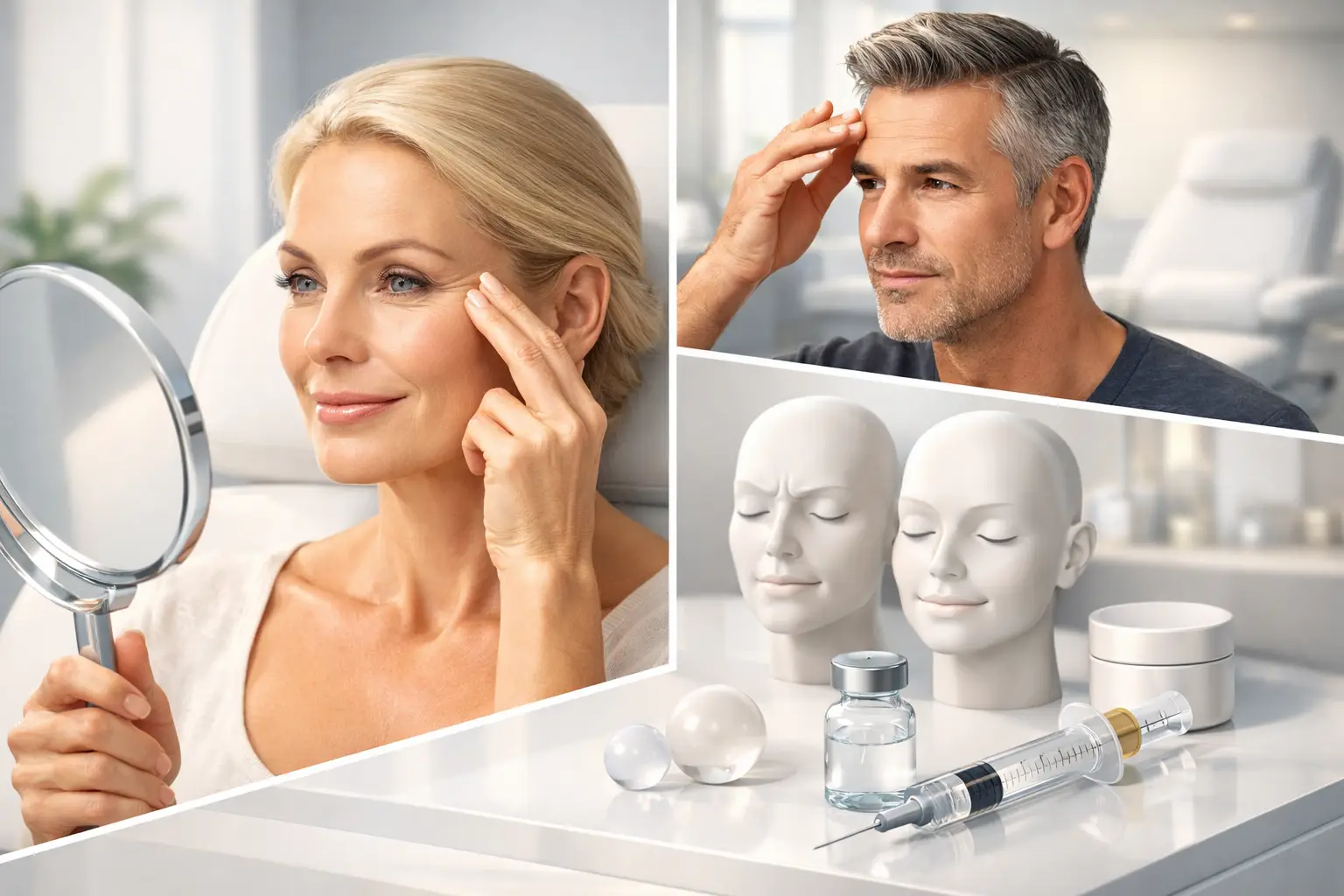
Those first lines often appear where your face is most expressive – across the forehead, between the brows, and around the eyes. For many people, botox for expression lines becomes a consideration not because they want to look different, but because they want to look less tired, less tense, or simply more refreshed while still looking like themselves.
Expression lines are a natural part of living well. They form through repeated facial movement over time, and they often become more noticeable as collagen, elastin and skin hydration gradually decline. The right anti-wrinkle treatment does not erase personality. It softens the intensity of certain movements so the skin has less opportunity to fold deeply, creating a more rested and elegant appearance.
How botox for expression lines works
Botox is the name many people use when talking about neuromodulator treatments. In practice, these treatments work by temporarily relaxing selected facial muscles that are responsible for dynamic lines – the lines that appear when you frown, squint, raise your eyebrows or smile.
This matters because not every wrinkle is caused in the same way. Expression lines are movement-related. If the muscle underneath keeps folding the skin in the same place, the line gradually becomes etched in, first during movement and then, in some cases, at rest. By reducing that repeated muscle action, treatment helps soften the visible line and can also slow the progression of deeper creasing.
The key word is selective. A well-planned treatment should not freeze the face. It should preserve natural movement while reducing the muscular pull that creates harsh or ageing-looking lines. That balance is where experience, facial assessment and dosing precision make a real difference.
Which expression lines respond best?
The areas most commonly treated are the horizontal forehead lines, the vertical frown lines between the eyebrows, and the crow’s feet at the outer corners of the eyes. These are classic dynamic lines and they often respond very well to neuromodulator treatment when approached with restraint and accuracy.
Frown lines are one of the most popular areas because they can create an unintended expression of stress, anger or fatigue. Softening this area often has a surprisingly positive effect on the whole face. It can make someone look calmer and more approachable without changing their features.
Forehead lines can also improve beautifully, although they need careful planning. The forehead is closely linked to brow position, so overtreatment can lead to heaviness or a flatter expression. Around the eyes, subtle treatment can reduce crinkling while still allowing a warm, natural smile.
There are also cases where expression lines do not respond fully with botox alone. If a line is deeply set at rest, if there is significant skin laxity, or if textural changes are contributing to the concern, a broader facial rejuvenation plan may be more suitable. This might involve combining anti-wrinkle treatment with skin resurfacing, skin quality treatments or dermal fillers, depending on the anatomy and the desired outcome.
Botox for expression lines versus static wrinkles
One of the most important distinctions in consultation is whether a line is dynamic, static, or a mix of both. Dynamic lines appear with movement. Static wrinkles remain visible even when the face is relaxed. Most patients have a combination, especially from their late thirties onwards.
Botox for expression lines works best on the dynamic component. If a crease has already become deeply engraved, the treatment may still help by stopping the skin from being repeatedly folded, but the improvement is often softer and more gradual. In those cases, patients usually achieve the best result when treatment is part of a personalised plan rather than viewed as a single solution.
That is why honest assessment matters. A polished result starts with understanding what is causing the line in the first place. Muscle movement, skin quality, sun exposure, facial volume loss and lifestyle all play a part.
What results look like when treatment is done well
The most elegant results are often the least obvious to others. Friends may say you look well rested or brighter, without being able to identify exactly why. That is usually the sign of good treatment planning.
Most patients begin to notice changes within a few days, with the full effect developing over roughly two weeks. The treated areas usually look smoother in motion, and the face may appear less tense overall. The aim is not to remove every line at any cost. It is to create a softer, fresher version of your natural expression.
Results are temporary and typically last several months, although this varies from person to person. Muscle strength, metabolism, treatment area and previous treatment history can all influence longevity. Some patients prefer a very soft first treatment, particularly if they are new to aesthetics. Others who have had treatment before may want slightly more refinement, while still keeping natural movement.
Safety, suitability and why consultation comes first
A premium result depends on more than the product used. It depends on anatomical knowledge, injector skill, a proper medical history and a clear treatment plan. This is not a treatment that should be approached casually, even though it is widely known.
A consultation should assess your facial movement at rest and in expression, the quality of your skin, the balance between the upper and lower face, and whether you are a good candidate for neuromodulator treatment at all. This is also the moment to discuss previous aesthetic treatments, your preferred outcome and any concerns about looking frozen or overdone.
Suitability varies. Some patients are ideal candidates for subtle wrinkle reduction. Others may benefit more from a different approach, or from combining treatments in stages. A thoughtful practitioner will explain these differences clearly and will never treat beyond what suits your face.
You should also be given clear aftercare guidance and realistic expectations. Mild redness, slight swelling or small injection marks can happen temporarily, but these effects are usually short-lived. What matters most is that treatment is carried out in a proper medical setting, with attention to safety, precision and follow-up.
Why a natural result depends on restraint
There is a reason sophisticated aesthetic medicine tends to favour less, not more. Expression is part of facial identity. When anti-wrinkle treatment is overused, the face can lose some of its harmony and softness. When it is used with restraint, it can preserve a more youthful look without making your features appear altered.
This is particularly important for adults who want to age well rather than chase an artificial standard of perfection. A natural result respects the way you smile, speak and react. It supports confidence because you still recognise yourself in the mirror.
At LA Clinik, this philosophy is central to treatment planning. The goal is subtle rejuvenation – softer lines, natural movement and results that feel refined rather than obvious. For many patients, that measured approach is what makes treatment feel reassuring rather than intimidating.
When to start treatment for expression lines
There is no single right age to begin. Some people develop strong frown lines in their early thirties, while others are not concerned until later. The better question is not when should everyone start, but when does treatment make sense for your face, your skin and your goals.
If lines are beginning to linger after expression, early treatment can sometimes help prevent them from becoming more deeply fixed. If lines are already established, treatment can still be worthwhile, but expectations should be realistic. Softer movement and a fresher appearance are very achievable. Complete removal of every crease is not always necessary, or even desirable, for a beautiful result.
A consultation is especially helpful if you are unsure whether your concern is mainly muscular, structural or skin-related. The answer is often more nuanced than patients expect.
A personalised approach gives the best outcome
No two faces age in exactly the same way. Even people of a similar age can have very different muscle patterns, skin quality and aesthetic priorities. That is why a tailored plan almost always achieves a better result than a standardised one.
For some patients, botox for expression lines is the ideal starting point. For others, the best result comes from treating expression lines while also improving skin texture, hydration or volume where needed. The advantage of a consultation-led clinic is that treatment can be built around the whole face, not just a single line.
If you are considering anti-wrinkle treatment, the most valuable next step is a professional assessment with someone who understands both facial anatomy and natural-looking aesthetics. The best rejuvenation is rarely dramatic. More often, it is the quiet confidence of looking refreshed, well cared for and entirely yourself.
Zostaw odpowiedź